

.svg)
.png)
.png)
🌎 Bearing the (large) load (tariffs) #275
Happy Monday!
FERC’s bid to accelerate large data center load interconnection is meeting state tariff regimes built to manage risk for ratepayers. This week, we dive into the consequences on risk, costs, and speed to power.
Don’t miss out: We graded the 2025 predictions you made in January to see what's come to pass, and you did pretty well! Check it out here. Think you can beat your score? Take our 2026 Predictions survey to place your bets on the year ahead. Plus, you’ll be entered to win a $50 gift card.
Take the 2026 Predictions Survey!
In deals, $587m for home energy solutions, $553m for renewable energy asset development, and $462 for geothermal project development.
In other news, the EU finalized its net-zero plans, Thailand released its first climate change law, and Doctor Copper is rallying.
Not a subscriber yet?
📩 Submit deals and announcements for the newsletter at hello@ctvc.co.
💼 Find or share roles on our job board here.
CTVC is powered by Sightline, the tactical market intelligence platform for energy and investment decision-makers.
Large load, larger questions
This year’s defining story has been the surge in speculative data center load and the scramble to carry it. That friction got federal this fall when the Department of Energy pushed FERC toward a federal framework for large-load interconnection. What was once clearly state domain, already writing their own spate of large-load tariffs, is drifting into federal territory, making it harder for utilities and data center developers to parse and plan around.
What happened
FERC proposed a standardized federal framework for connecting large sources of demand to the transmission system, mirroring the process long used for generators. (There was such heavy interest that the comment period got extended.) Currently, it has three main elements:
- Defining “large load” as any source of demand of 20MW or more seeking direct interconnection to the transmission grid.
- Asserting federal jurisdiction and creating a standardized process intended to speed review. Large loads would submit uniform documentation and face shorter decision timelines of ~60 days with penalties designed to deter speculative queue positions.
- Requiring projects to pay network upgrade costs, explicitly aiming to protect ratepayers from higher bills while ensuring new loads can access desired grid improvements.
Speed’s the motivation: Hyperscalers want power now, and federal policymakers want AI infrastructure built quickly. But that urgency crashes into state-level policy already underway.
Why it matters
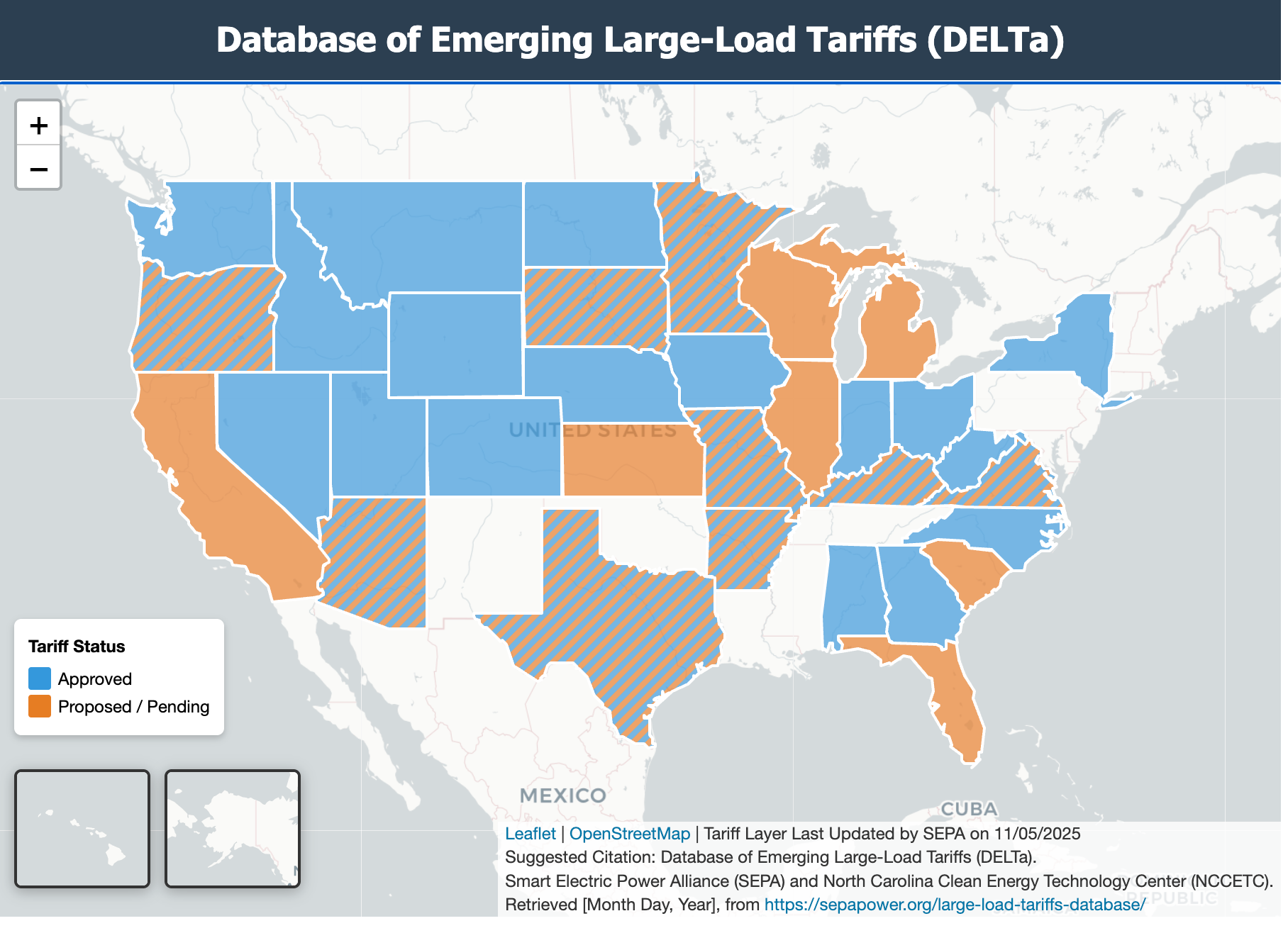
States have already crafted large-load tariffs, often in partnership with the hyperscalers themselves:
- Ohio’s tariff requires new data centers above 25MW to pay for at least 85% of subscribed load regardless of actual usage, for up to 12 years, with a ramp-up period and exit fees.
- Indiana Michigan Power’s large load settlement covers new or expanded facilities at 70MW+ (or 150MW aggregated). Customers pay for at least 80% of contracted demand, even if actual usage is lower, with contract term of 12 years, with an optional up to 5-year load ramp.
- In Virginia, Dominion’s new GS-5 class for customers demanding 25MW+ requires customers to pay a minimum of 85% of contracted distribution and transmission demand and 60% of generation demand, among other requirements, effective in 2027.
- And in Nevada, the Clean Transition Tariff, designed by Google and NV Energy, initially to allow Google to buy power from Fervo Energy’s Corsac project. But the tariff can be used by any load over 5MW, requires the energy supply agreement to match the lifetime of the asset, and includes an uplift to pay for grid investment.
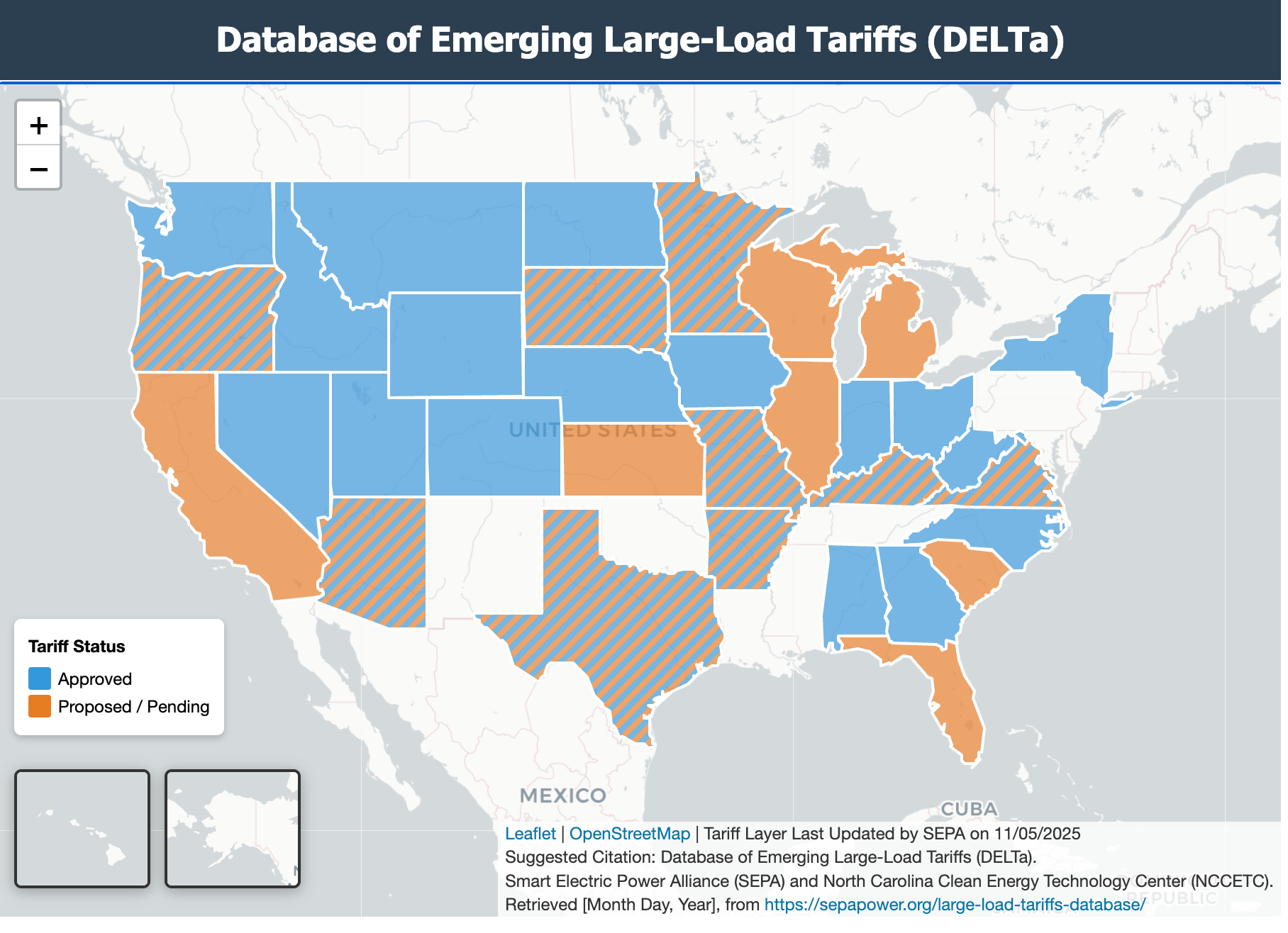
There’s a big question underlying these rules: what happens if the load never shows up? Large-load tariffs answer that by making developers pay anyway. High minimum payments over 1+ years protect utilities and ratepayers if utilization falls short and force developers to turn reservations into real demand by filling buildings or bringing in tenants.
The speculation moves out of interconnection queues and into real estate, reducing rate shock, but not eliminating stranded asset risk. If several projects commit and only some materialize, utilities can still overbuild. Substations and transmission sized for a boom may sit underused if demand shrinks. Those assets may prove valuable later as electrification or industrial load grows, but timing matters, and regulators will fight over whether “useful later” justifies ratebasing today. Ohio’s approach, allowing customers to reassign retail capacity, is an early attempt to manage that.
Meanwhile, adding another new federal process risks stepping on states’ toes, creating even more uncertainty, and potentially creating a less effective process; all of which will delay the speed to power hyperscalers so desperately want.
Key takeaways
- Tariff design now drives data center siting. Faster, clearer interconnection attracts capacity, but loose rules risk higher bills while tight rules push projects elsewhere. As developers grow more flexible on location, predictable timelines and consumer protection increasingly determine where projects land.
- Federal speed meets state risk control. DOE and FERC want power online fast. States and utilities want protection if speculative load falls short. Poor coordination could delay projects and still leave consumers exposed.
- Large-load tariffs are reshaping the grid. They influence whether data centers bring their own power, co-locate with generation, rely on storage and flexibility, or trigger new plants and transmission. Done well, they strengthen the system. Done poorly, they lock in assets built for demand that never arrives.
Deals of the Week (12/8-12/15)
Late-Stage / Growth
⚡ Fervo Energy, a Houston, TX-based geothermal project developer, raised $462m in Growth funding from B Capital, Breakthrough Energy Ventures, Capricorn Investment Group, Mitsubishi Heavy Industries, Mitsui & Co., Sabancı Climate Ventures and other investors.
✈️ Boom Supersonic, an Englewood, CO-based supersonic aircraft developer, raised $300m in Series B funding from Darsana Capital Partners, ARK Invest, Altimeter, Bessemer Venture Partners, Robin Hood Ventures, and Y Combinator.
🔋 Blue Current, a Hayward, CA-based solid state battery developer, raised $80m in Series D funding from Allen & Company, Amazon, Koch Disruptive Technologies, Piedmont Capital Investments, and Rusheen Capital Management.
🚢 bound4blue, a Barcelona, Spain-based suction sail systems developer, raised $44m in Growth funding from GTT Strategic Ventures, Kai Capital Markets, Monaco Asset Management, Motion Ventures, Shift4Good and other investors.
⚡ Qargo, a London, England-based fleet management software, raised $33m in Series B funding from Sofina and Balderton Capital.
🔋 Haven Energy, a Los Angeles, CA-based residential solar and storage provider, raised $20m in Growth funding from California Infrastructure Bank, Carnrite Ventures, Chaac Ventures, Comcast Ventures, Giant Ventures, and other investors.
🛰 FullDepth, a Tokyo, Japan-based ocean-based carbon removal company, raised $6m in Series D funding from Aozora Corporate Investment, Beyond Next Ventures, Drone Fund, JMTC Capital, Zenrin Future Partners and other investors.
🌾 Veragrow, a Rouen, France-based vermicompost-based biostimulants producer, raised $5m in Growth funding from Odyssée Venture, Caisse d’Épargne Normandie, Groupe All Sun, and Normandie Participations.
Early-Stage
🚀Overview Energy, an Ashburn, VI-based space solar power energy developer, raised $20m in Seed funding from Lowercarbon Capital, Prime Movers Lab and Engine Ventures.
🌬 Spoor, an Oslo, Norway-based bird monitoring for wind farms developer, raised $9m in Series A funding from SET Ventures, EnBW New Ventures, Orsted Ventures, and Superorganism.
🌊 Orbital Marine, a Kirkwall, Scotland-based tidal energy developer, raised $9m in Growth funding from PXN Ventures and Scottish Enterprise.
🥩 Melt&Marble, a Göteborg, Sweden-based precision fermentation fats developer, raised $9m in Series A funding from Industrifonden, Beiersdorf, Catalyze Capital, European Commission, Valio and other investors.
🌾 Wakuli, a Watergang, Netherlands-based specialty coffee supplier, raised $6m in Series A funding from European Circular Bioeconomy Fund and Rabobank.
🚀 Helical Fusion, a Tokyo, Japan‑based nuclear fusion energy developer, raised $6m in a Series A from Ecrowd.
Other
⚡ Elvy, an Östermalm, Sweden-based home energy subscription provider, raised $587m in Debt funding from Scayl.
⚡ Potentia Energy, a Sydney, Australia-based renewable energy assets developer, raised $553m in PF Debt funding from BNP Paribas, Bank of China, Mizuho Bank, Societe Generale, Sumitomo Mitsui Banking Corporation, and Westpac.
✈️ Eve Air Mobility, a São Paulo, Brazil-based eVTOL aircraft developer, raised $40m in Debt funding from Brazilian Development Bank.
Exits
⚡ Alinta Energy, a Sydney, Australia-based energy generator and retailer, was acquired by Sembcorp for $6.5b.
⚡ Shepherd Power, a Houston, TX-based advanced nuclear reactors developer, was acquired by Natura Resources for an undisclosed amount.
🌳 Kateri, a San Francisco, CA-based regenerative ranching programs provider, was acquired by Cultivo for an undisclosed amount.
⚡ Solar Choice, a Sydney, Australia-based solar and battery comparison service provider, was acquired by Flow Power for an undisclosed amount.
🔁 ClearGen, a Charlotte, NC, US‑based distributed energy infrastructure financier, was acquired by CBRE Investment Management for an undisclosed amount.
🔋 Primus Power, a Hayward, CA-based flow battery energy storage developer, filed for Bankruptcy.
Funds
💰 FoodLabs, a Berlin, Germany-based early-stage food-tech and ag-tech venture capital firm, raised $122m for Fund III, focusing on sustainable food, agriculture, health, and climate innovation.
💰 Ada Ventures, a London, UK‑based pre‑seed inclusive venture capital firm, announced its final close of $80m for its Inclusive Alpha Fund II, backing diverse pre‑seed and seed‑stage founders across sectors including climate equity, economic empowerment, and healthy ageing.
💰 Transition VC, a Bengaluru, India-based energy-transition venture capital firm, raised $77m for its debut fund, targeting early-stage startups in energy transition sectors.
This is a sample of deals available for Sightline clients. Can’t get enough deals?
Request a Sightline Climate demo
In the News
The European Union agreed to a legally binding target to cut greenhouse gas emissions 90% by 2040, updating its Climate Law to lock in the bloc’s path to net zero by 2050. The deal, finalized after COP30, includes a one-year delay to the ETS2 carbon market for buildings and transport and allows limited use of carbon removal and international credits capped at 5% of the target. The legal target provides long-term certainty that should boost clean energy and carbon credit market.
Thailand approved the principles of its first-ever Climate Change Act, creating a comprehensive legal framework that introduces national climate governance, carbon pricing tools, an emissions trading system, and mandatory emissions reporting. The law establishes new oversight bodies, a state-backed climate fund, recognition of carbon credits as legal assets, and provisions for carbon taxes and future cross-border carbon adjustment measures, with details to follow in secondary legislation.
It was a big week for geothermal, as Eavor Technologies began delivering electricity to the German grid from its Geretsried project, the world’s first commercial closed-loop geothermal system, while Fervo Energy raised $462m, to scale enhanced geothermal projects in the US. Eavor’s milestone validates its water-free, geology-agnostic Eavor-Loop technology, and Fervo’s funding round — adding Google to its investors — signals growing confidence as the company moves toward utility-scale deployment.
Copper prices hit a record as US stockpiling ahead of potential tariffs tightened supply and China signaled a more growth-supportive policy stance, boosting demand expectations. LME futures rose above $11,700 a ton, with analysts warning inventory draws could deepen an already tight refined copper market. Higher copper prices raise cost and bottleneck risks for grids, EVs, and data centers, reinforcing the need for expanded mining and recycling capacity.
A federal judge struck down President Trump’s executive order halting permits for all wind projects on federal lands and waters, ruling the blanket freeze “arbitrary and capricious” and in violation of administrative law. The decision follows a lawsuit by 17 states and Washington, D.C., after the order stalled offshore and onshore wind developments and sought to revoke previously issued permits. For the energy transition, the ruling removes a major legal barrier to U.S. wind deployment and improves policy certainty, though developers may still face regulatory risk under a hostile federal administration.
Pop-up
The new permitting act is speeding to Congress this week.
New McKinsey adaptation report is out.
After a short circuit, US’ EV charging funds are back online.
Bill Gates says geoengineering is a last-resort sunblock.
SpaceX to launch massive IPO.
Opportunities & Events
💡 The National Climate Tech Accelerator (NCTA): Join the new accelerator and competition designed to accelerate the growth of UK climate tech startups through support from Barclays Eagle Labs and Sustainable Ventures.
📅 Queer Decarbonization Summit: Join LGBTQ+ climate leaders for a curated retreat-conference in nature with leaders from Galvanize, Generate, Elemental Impact, Google, Apollo, and more. In the West, it will be July 6-8, 2026, near SF, and the East will be October 6-8, 2026 near NYC.
Submit your Events & Opportunities
Jobs
Investment Associate @Zero Infinity Partners
Electrical Project Engineer @Planted Solar
Civil Project Engineer @Planted Solar
Solution Engineer @Planted Solar
Part-Time Inside Sales Representative @Composer
Software Engineer, Fullstack @Eagle
📩 Feel free to send us deals, announcements, or anything else at hello@ctvc.co. Have a great week ahead!


.jpg)

.jpg)
.png)
.png)
.png)


