

.svg)
.png)
.png)
It’s BYOCapacity, not BYOGeneration
Earlier this month, Sightline had the pleasure of hosting Dana Guernsey, CEO of Voltus, for a client-only session on how the distributed energy resources (DER) platform and virtual power plant (VPP) aggregator is helping data centers accelerate speed to power. The discussion focused on Voltus’s recently launched Bring Your Own Capacity (BYOC) product and how it enables data center development by unlocking flexible capacity already available on the grid.
Why is flexibility needed?
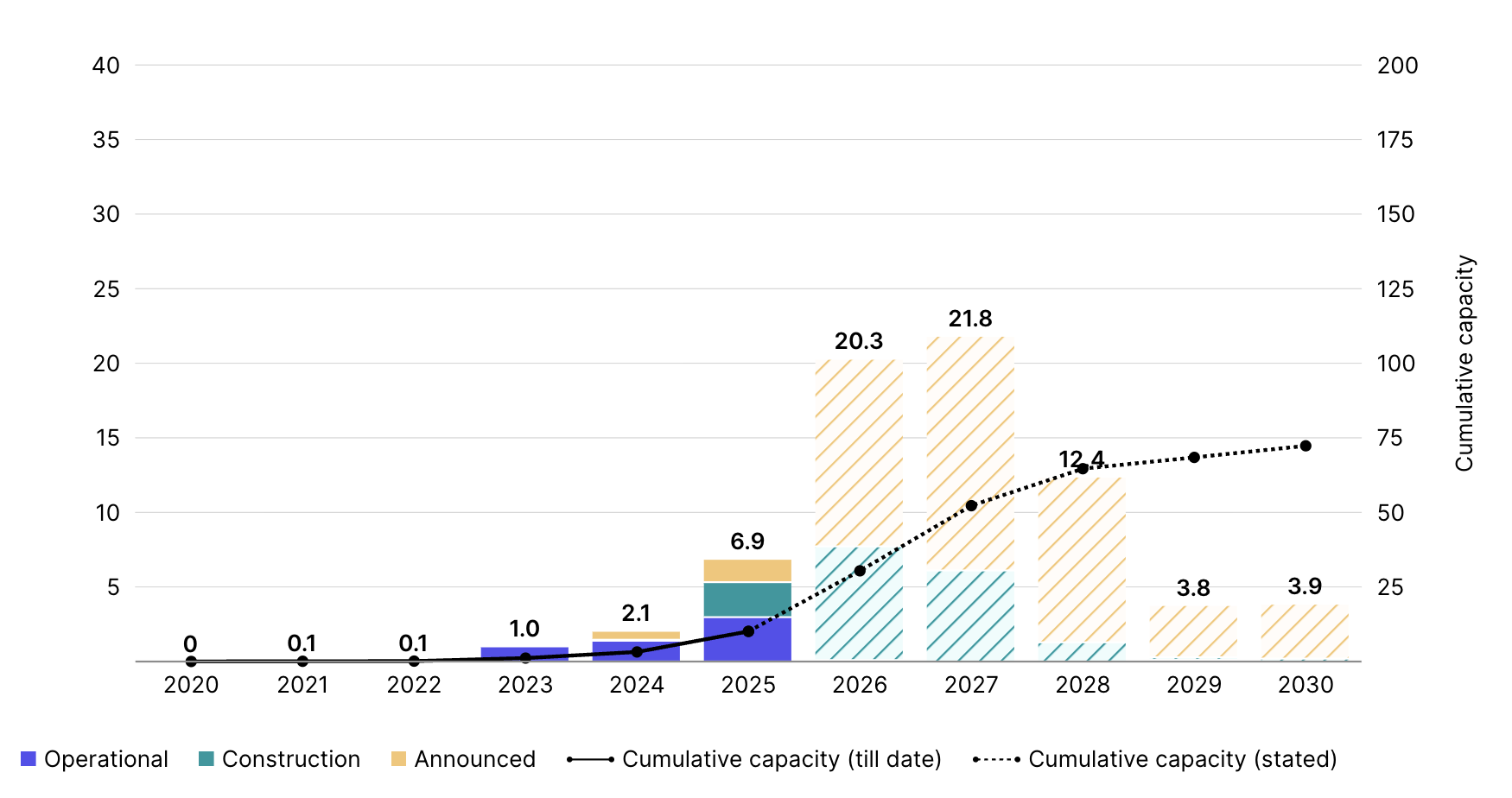
Tens of gigawatts of data center capacity are slated to come online in the next few years, with more than 20GW next year alone (see graph below), but the grid infrastructure required to serve it cannot be built nearly as quickly. Transmission upgrades, substations, and interconnections take years, not months. Even onsite or colocated generation faces long equipment lead times, fuel constraints, and permitting hurdles. The result is a widening gap between when data centers need power and when traditional supply-side solutions can realistically deliver it.
That gap is why flexibility has dominated the speed-to-power conversation this year. When a data center cannot immediately access firm grid capacity, one option is to reduce or shift its grid demand during periods of system stress, allowing utilities to avoid building new infrastructure solely to meet a short-lived peak. Flexibility can take many forms: shifting compute tasks across time or locations, temporarily relying on backup power or storage, or sourcing additional capacity from existing grid resources. In each case, the goal is the same: enable data centers to come online faster by working within today’s grid constraints rather than waiting for upgrades.
What is BYOC?
In September 2025, Voltus launched Bring Your Own Capacity, a way to allow data centers to leverage existing flexibility on the grid to meet their power needs faster. Rather than waiting years for new generation, transmission, or substation upgrades, BYOC allows data centers to source accredited capacity from a virtual power plant composed of flexible loads that already exist on the system.
This approach works because, in markets such as PJM, MISO, and ISO New England, capacity is a clearly defined and tradable product. Grid operators accredit resources based on their ability to perform reliably during system peaks, regardless of where those resources are physically located. Voltus leverages this market structure by aggregating distributed energy resources (such as flexible commercial, industrial, and residential loads) through its existing VPP platform and delivering that accredited capacity to data centers.
Voltus’ BYOC product aligns a growing body of research that supports leveraging existing capacity to accommodate large loads:
- A landmark study from Duke University found that curbing demand for only 0.25 percent of the time, roughly twenty two hours per year, could make more than 100GW of capacity available nationwide.
- RMI analysis shows that nearly all of the next decade’s forecasted grid needs could be met by fast, affordable, flexible solutions, including energy efficiency, virtual power plants, advanced transmission technologies, and new generation sited at existing interconnection points through approaches like clean repowering and power couples.
- Most recently, a whitepaper on flexible data centers published by Camus Energy, Encoord, and Princeton Zero Labs found that combining flexible grid connections with bring your own capacity arrangements, data centers can connect to the grid 3-5 years faster and mitigate new system buildout, shifting remaining costs onto the data center and reducing the risk of rate hikes for other customers.
How Voltus' BYOC actually works
When data centers approach Voltus about BYOC, the process typically unfolds in three steps:
1. Location and constraint assessment
Voltus begins with a detailed analysis, examining how the utility defines its constraints, whether the issue is local or system-wide, and the size and flexibility of the surrounding load pool.
2. Market structure evaluation
Regions with established capacity accreditation rules allow for faster deployment. PJM is a prominent example, with clearly defined processes for qualifying capacity resources and identifying local constraint zones.
3. VPP aggregation and capacity transfer
Voltus aggregates distributed energy resources (DERs) together to form a virtual power plant, submits it for market accreditation, and transfers the accredited capacity to the data center or its utility.
In regions without a formal capacity construct, BYOC is still possible but requires deeper utility engagement. For example, a utility-run demand response program or inclusion of load flexibility solutions in a utility’s integrated resource planning process are needed to establish a shared definition of capacity and reliability.
BYOC > BYOG
As Dana said, “It doesn’t make sense to build everything on-site - that's inherently inefficient. The idea that we'd need to match new supply in the exact footprint and to the exact amount of a new large load not only isn't a great use of capital, but it isolates the benefits of that capital. BYOC provides speed-to-power yes, but it also allows the data center to invest in the local community. Local businesses and homeowners can participate in VPP programs, and benefit from a broader approach to making their grid more affordable and reliable overall.”
Much of the current conversation around speed to power has focused on “bring your own generation” or BYOG. Some developers view colocated on-site or nearby power as the simplest way to solve grid constraints.
But this isn't a silver bullet. In many cases, the limiting factor is not generation itself, but the infrastructure that delivers it. Substations, distribution circuits, or transmission interfaces may be constrained even when generation is available. As a result, bringing your own generation is not a universal solution.
There are also community benefits from BYOC: instead of concentrating value solely in on-site assets, this approach distributes economic benefits across the surrounding region by directing revenue to local facilities participating in the VPP.
Does flexibility compromise on uptime?
“A myth is that flexibility means sacrificing uptime. That’s where batteries and distributed generation come into play.” – Dana Guernsey
A common misconception about flexibility is that reducing load from the grid necessarily compromises uptime.
There are multiple ways data centers can provide flexibility. One option is shifting compute workloads across time or between facilities (with EmeraldAI leading the way). Voltus too can control AI compute loads, though Guernsey highlights that most customers still have little interest in doing this.
What's more immediately realistic is shifting temporarily to backup power. Data centers are unlikely to drop workloads or interrupt services because the grid needs relief. The value of uninterrupted service is simply too high. As Brian Janous of Cloverleaf has described it, the “Watt-Bit Spread” makes investments in onsite storage and backup systems economically obvious.
From this perspective, flexibility does not mean turning the power off but rather having multiple ways to meet the power demand of the data center, relying on onsite storage or backup generation for a few hours while continuing business as usual.
Challenges of deploying BYOC
“Building out the BYOC tech – that is done. It’s now all about winning the hearts and minds on the market and regulation side” – Dana Guernsey
The primary challenge for Voltus has been educating operators. Many utilities and regulators might assume that generation and load must exist in the same physical location. This assumption could be true in some cases where there is no nearby load or the constraint is extremely localized, but often it overlooks the fundamental role of the transmission and distribution system, which exists to move power across regions and enable diversity of resources.
But momentum is shifting toward embracing the data center boom. Utilities are increasingly motivated by reliability pressures and affordability concerns, while regulators are acting with greater urgency than in past cycles. The recent surge in ANOPR comments reflects growing recognition that flexibility is becoming critical.
Where do we go from here?
The discussion ended with a few actionable steps that could accelerate adoption of BYOC:
- Engage directly with public utility commissions and utility territories so regulators and utilities hear firsthand about emerging business models like BYOC
- Build familiarity with flexibility-based solutions among policymakers and stakeholders to speed adoption and deployment
- Deploy batteries broadly across the grid—“smeared across the grid,” as Guernsey put it, to unlock system-wide reliability and capacity value
- Act now while conditions align, as reliability, affordability, and rapid load growth are converging to create a narrow window for innovation


.jpg)

.jpg)
.png)
.png)
.png)


